
The Ultimate Guide to Diving With Bull Sharks at Bat Islands Costa Rica
By Demi Johnson, Dive Master
Scuba diving is a popular activity in Playas del Coco. In fact, Playas del Coco is one of the best places to scuba dive in Costa Rica and many tourists choose Coco as their Costa Rica destination for the primary purpose of diving.
We’ve already talked about the basics of diving in Playas del Coco but today, we’re going to talk about one particular dive site – the Bat Islands, also known as Isla Murcielago.
Don’t Forget Travel Insurance!
About Bat Islands (or “Isla Murcielago”)
The local diving in the area around Coco is brilliant in its own right but for advanced divers in Playas del Coco, the real diving thrill is just 30 miles northwest, in the protected waters of the Santa Rosa National Park.
The Bat Islands (Isla Murcielago) is becoming increasingly popular with divers from all over the world, for one very special reason – bull sharks. These bull sharks congregate in the shallow waters around the island, offering the rare chance to come face to face with an animal which is often feared and misunderstood. The Bat Islands are the only destination in Costa Rica to dive with bull sharks.
The Bat Islands are also a good place to view the Pacific Giant Mantas and the smaller Devil Rays, which can sometimes be seen swimming in schools of a few hundred or more. Sea life, in general, is abundant at the Bat Islands but the main draw for most divers is definitely the opportunity to dive with bull sharks.

Are Bull Sharks Dangerous?
Bull sharks have gotten themselves quite the reputation, and are regularly declared the most aggressive species of shark. There is truth in the fact that they contribute to a high percentage of deaths and attacks. However, this can be attributed to their love of shallow, murky water, and their tendency to lurk in river mouths and estuaries, where salt and freshwater meet. Bull shark attacks on divers are incredibly rare, and there has never been a recorded incident at Bat Islands. When diving with bull sharks at Bat Islands, you will quickly realize they don’t like to get close to us humans.
It’s also important to remember that shark attacks in general are extremely rare. In fact, things like escalators, hot dogs, and selfie sticks (yes, really), kill more people annually than sharks.
Is Diving With Bull Sharks Ethical?
When animals are involved in any activity, there is always a question of ethics. Bat Islands is incredibly unique, as no one ever “chums” the water or feeds the sharks, and yet there is a very high chance of seeing them during several months of the year. With no human intervention, the sharks’ behavior remains completely natural, and they don’t learn to rely on humans as a source of food. This does mean that no one can guarantee the sharks will be sighted, so it can be a good idea to ask around the dive shops in Playas del Coco about recent sightings of bull sharks at Bats Island.
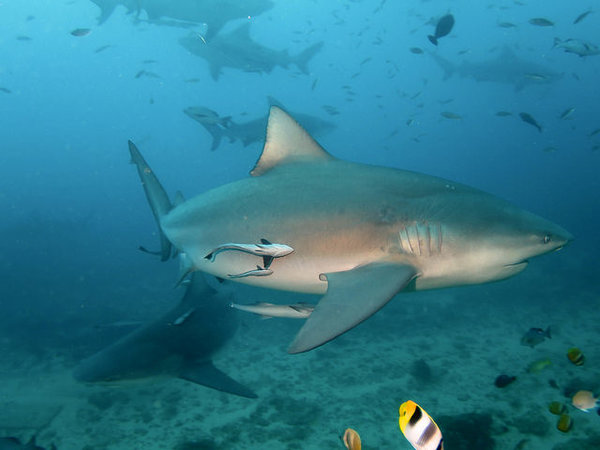
Diving With Bull Sharks in Costa Rica
Reaching Bat Islands takes approximately 45 minutes to an hour. Most dive shops take you to two separate dive sites, starting with the aptly named, “Big Scare”.
When you arrive, the captain will not drop the anchor. You will be close to the rocky islands, and so a quick descent with no line is required. There can be strong currents, unpredictable visibility and a maximum depth of 30 meters. Most dive shops will request that you be at least an advanced diver for these reasons, and rightly so.
Once you have descended, your guide will lead you away from the island into the deep. From here you will swim slowly, all the while trying to spot the distinctive silhouette of the huge bull shark. When one is spotted, there are usually more lurking around, and your guide may choose to stay put and let the curious sharks circle the group of divers. If it is your first time seeing a bull shark, you will likely be in awe of their sheer size.
In addition to the bull sharks, jacks, groupers, octopus, eel, mahi mahi and even manta rays are often found at the Big Scare dive site.
The dive is usually around 30 – 40 minutes, and it is important to frequently monitor your air when at such depth. A dive computer will also be a good investment for this trip, and you should keep an eye on your no stop limit.
Your second dive will likely be “Black Rock”, which is a beautiful dive around a rocky pinnacle, and full of life. White tip reef sharks, eagle rays, moray eels and huge schools of fish love to congregate here. Frequently look upwards, as you may be lucky enough to spot a manta ray. This area attracts big marine life, and if you listen carefully you may be able to hear whale song! I have heard reports of whale sharks, pilot whales, false killer whales and even orcas being seen by divers.
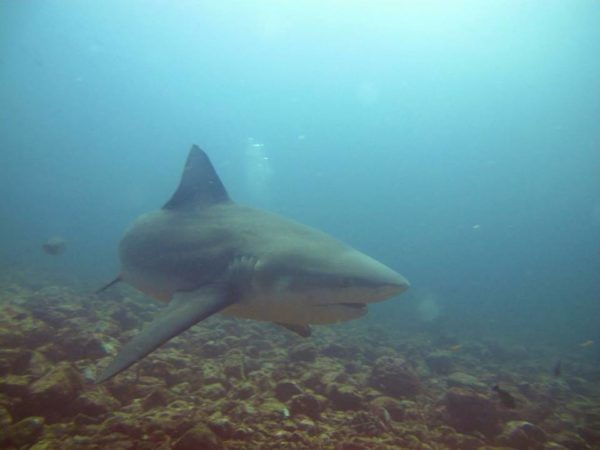
When Is The Best Time To Dive With Bull Sharks at Bat Islands?
Generally, the best time to see bull sharks at Bat Islands is between May and November. Outside of these months, the dive shops tend to stop sailing out to the islands, as the seas and weather become more unpredictable. During July/August, water temperature peaks around 28 degrees and so may be more comfortable.
What To Pack For Your Diving Adventure at Bat Islands
If you feel the cold, bring some extra underlayers like a rash guard or vest. There should be water provided by whichever dive center you go with, but it is always good to bring drinks and snacks with you. If you have an underwater camera, now is the time to use it!
Sunscreen is always a must and we recommend purchasing via Stream2Sea, who are working towards ocean conservation with coral-friendly sunscreen, after sun, and hair care products. Use code ExpCoco at checkout for 10% off your order!
Demi is a keen traveler, writer and dive instructor. She lived in Playas del Coco last year, but now currently works in Malta. She loves to write about places she’s been, travel tips and diving.


